
St. Clair County Criminal Court Cases
The Circuit Court of the Twentieth Judicial Circuit has original jurisdiction over St. Clair County felony, misdemeanor, and traffic cases. Its Circuit Clerk is the official custodian. Police may start a traffic or misdemeanor matter with a Uniform Traffic Citation or Non-Traffic Complaint. Prosecutors review felony referrals and decide which counts to file. That distinction matters because an arrest report records the officer's allegation, while the clerk file records the charge that entered court.
Case numbers pair a year with a category and sequence. CF identifies a filing with at least one felony count. CM marks a misdemeanor. MT covers DUI and major traffic matters, while TR covers other traffic. MR is a miscellaneous remedy category that can include search warrants or an expungement petition. It does not mean misdemeanor. The clerk's official case-type list is the best check when a code is unclear.
St. Clair Court Codes Decoded
A name search limited to CF can miss a CM or MT case. Search adjacent categories and spelling variants, especially when an alias may have been used. The category describes the file, not the grade of every offense within it.
The county's case-category display shows how the clerk labels these records.
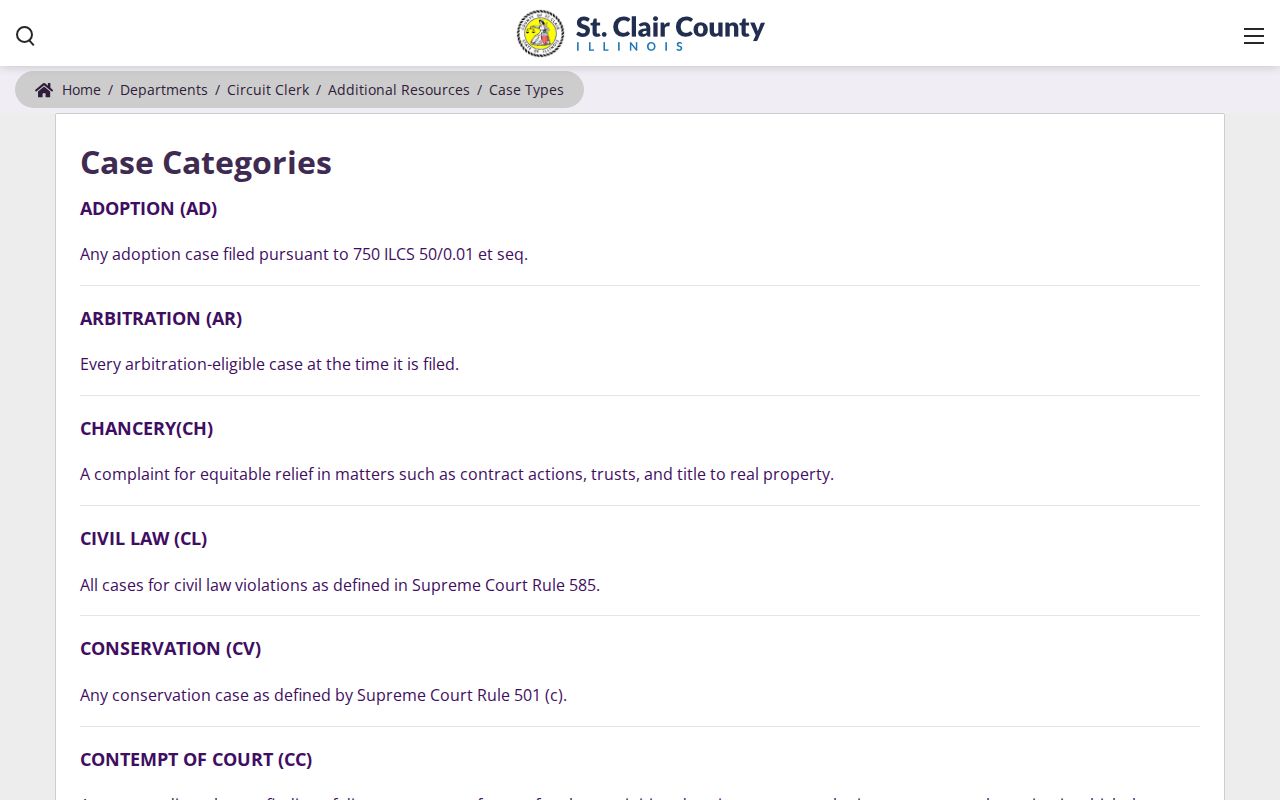
The image helps a reader choose the right category before deciding that no St. Clair County court record exists.
Searching St. Clair County Case Records
The free Circuit Clerk Court Record Search offers general case status, history, dates, and disposition. The clerk warns that it is a brief summary, not the official court record. Use it to locate the file, then verify key facts in the pleadings, orders, half sheet, file jacket, or certified disposition.
- Accept the clerk's summary-only and no-resale terms.
- Choose the party-name, case-number, or dated criminal-docket path.
- Enter the legal name or the year, category, and sequence from the case number.
- Review status, scheduled events, docket entries, disposition, and sentence fields together.
- Request the exact pleading or certified order from the clerk when the summary is not enough.
| Field Label | Type | Required | Notes |
|---|---|---|---|
| Terms acceptance | Consent | Yes | Acknowledges limits |
| Party name | Text | Name path | Try aliases and spelling variants |
| Case number | Text | Number path | Year, category, sequence |
| Case category | Filter | No | CF, CM, MT, TR, or MR |
| Docket date | Date | Docket path | Schedules can change |
Why St. Clair Summaries Fall Short
The county's free result may omit remote document images even though a physical file exists. It may also reflect a hearing date that changed after a continuance. The Circuit Clerk search terms tell users to verify information with the file contents and prohibit commercial resale or republication.
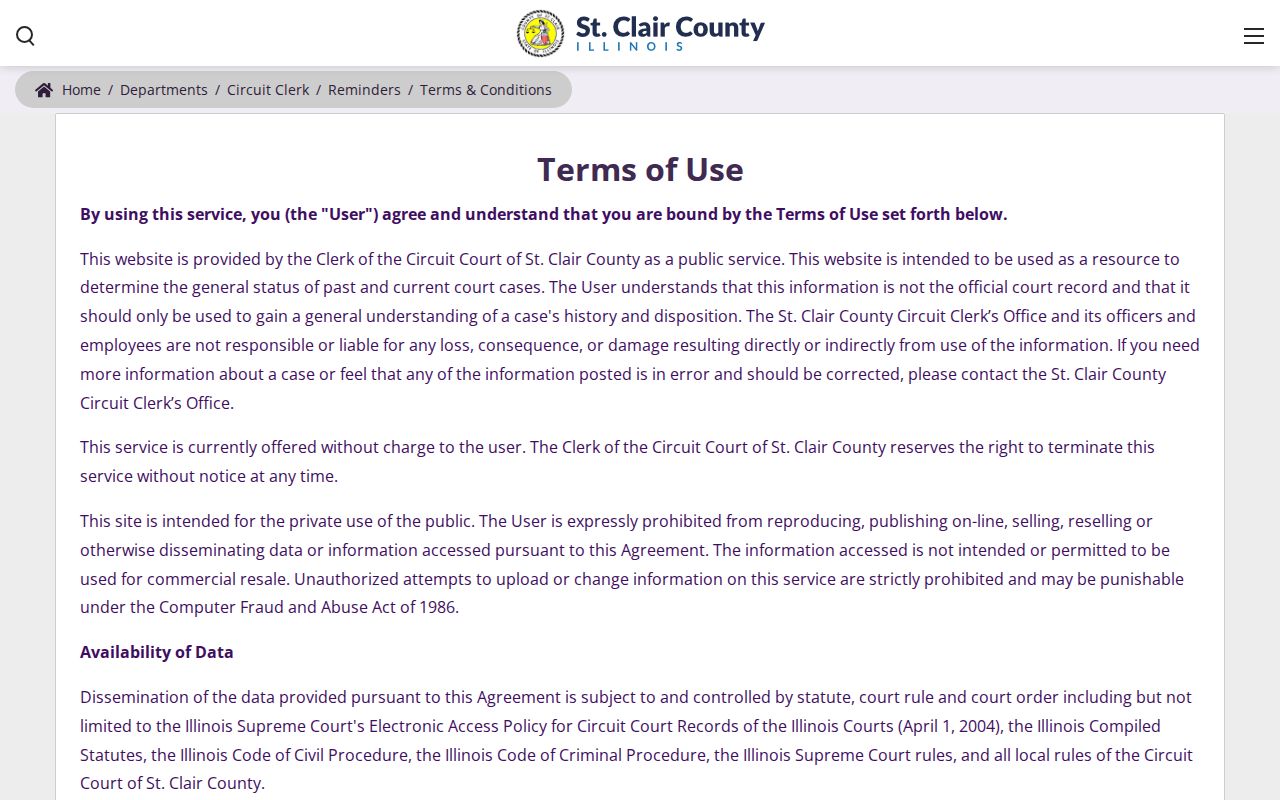
That warning is why a screen result should be treated as a locator, not as a certified St. Clair County judgment.
Inside a St. Clair Case File
A public St. Clair County case summary can tie the defendant and case number to the filing date, division, judge, lawyers, charges, hearings, and result. Its event line may show a complaint, information, or indictment; a warrant; counsel's appearance; motions; a plea or trial; judgment; sentence; probation; revocation activity; and closure. Read the chronology rather than one isolated field.
| Case number and court | Year, category, sequence, and assigned division |
|---|---|
| Charging document | Complaint, information, indictment, and filed counts |
| Docket entries | Chronological filings, settings, orders, and returns |
| Hearing dates | Scheduled time, room, and later continuances |
| Disposition and judgment | Dismissal, plea, verdict, or other final action |
| Sentence and conditions | Custody, probation, orders, and public financial entries |
Certified St. Clair Court Copies
For an official pleading or order, use the Circuit Clerk's online copy request. Supply contact and mailing details, the year, type, number, participant names, whether certification is needed, and the document or filing date sought. The clerk quotes the cost before fulfillment. Cash, business check, and money order are accepted, but personal checks are not. Email delivery carries the same copy cost as mail or in-person delivery.
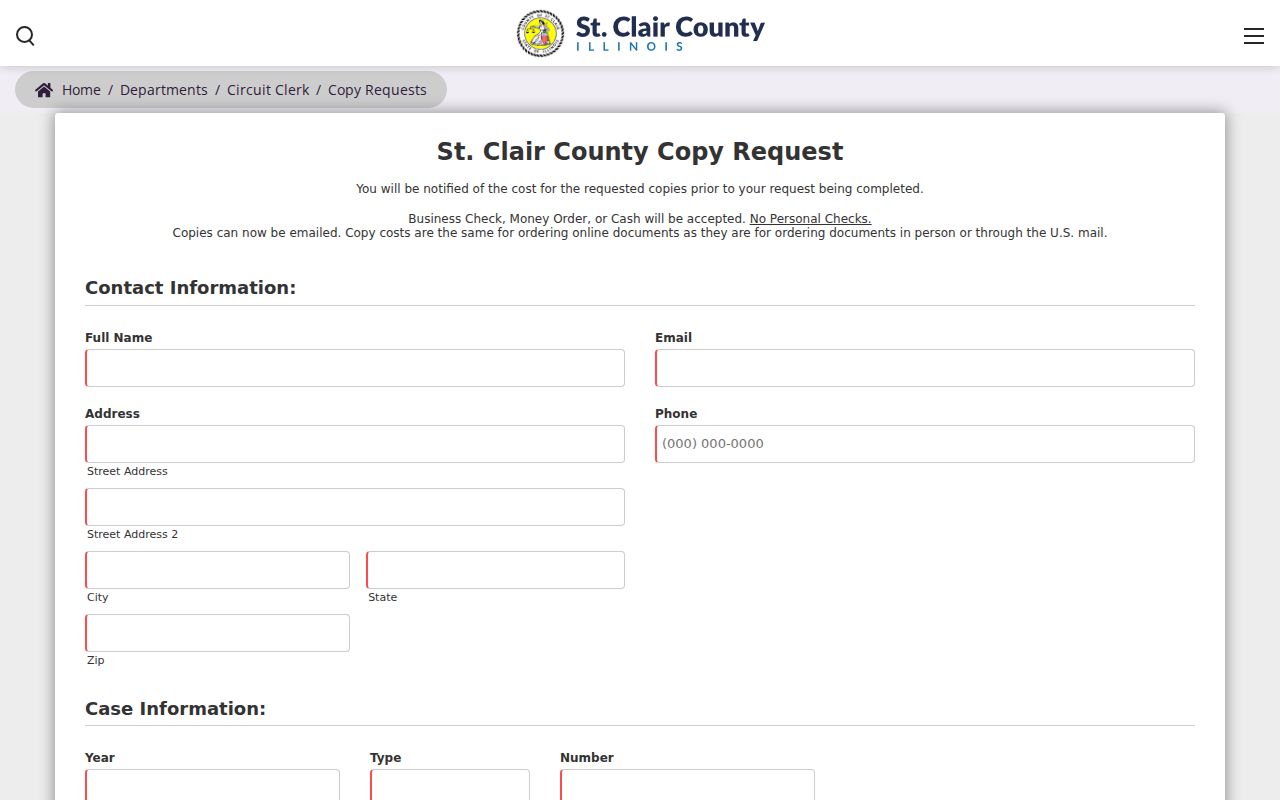
The form is most effective when the request names one document instead of asking broadly for every criminal court record.
How a Criminal Case Moves
The St. Clair County State's Attorney reviews felony referrals. A case may reach a preliminary hearing or grand jury before arraignment. Traffic and misdemeanor files often start with a citation or complaint. Motions, negotiated pleas, or trial follow, with sentencing only after conviction.
Case flow: Charges Filed › Arraignment › Pretrial › Plea or Trial › Disposition › Sentencing
The county's local criminal court process explains the prosecutor's role.
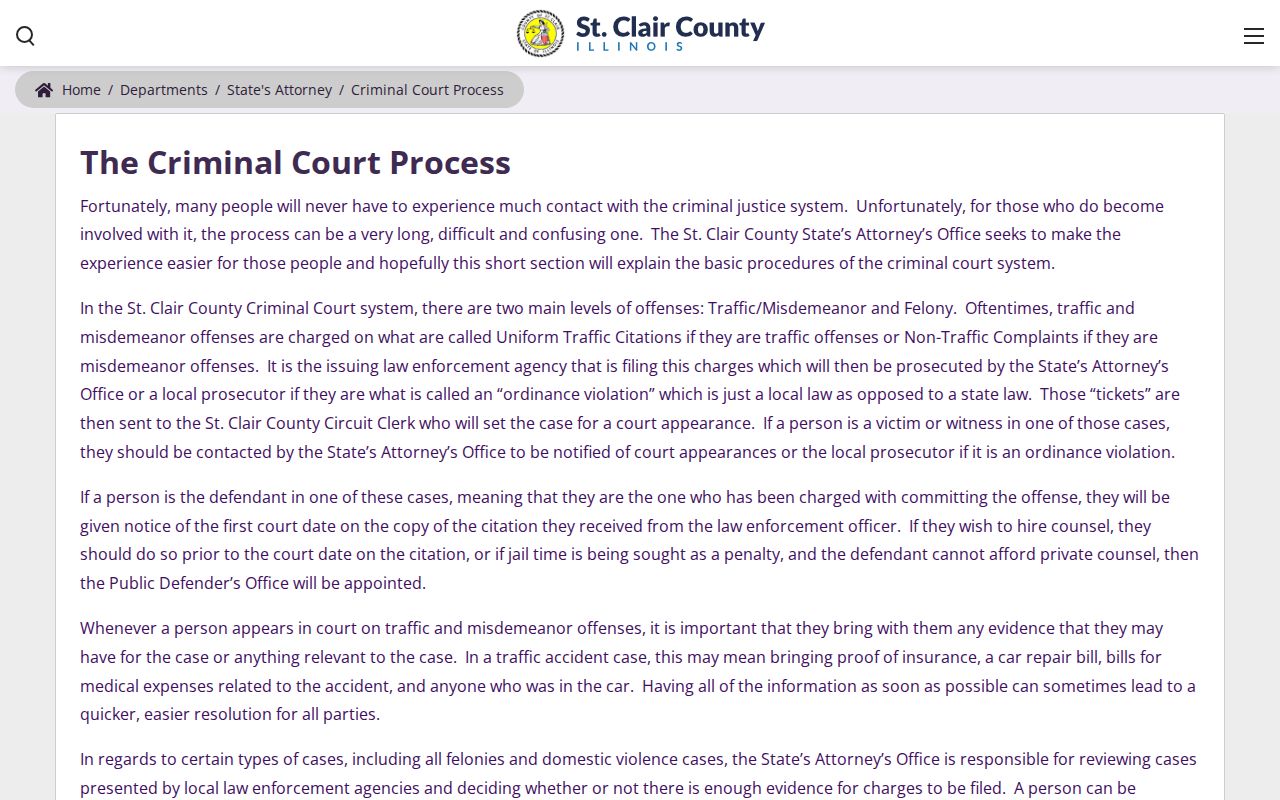
The local flow also shows why booking is not part of the court file's formal charging stage.
Booking Charges Versus Filed Counts
A police officer records charges believed to support an arrest. The prosecutor may file different counts, reduce them, add a supported count, or file no case. The court then records its own disposition. Compare all three stages before drawing a conclusion: the agency arrest report, the prosecutor-filed CF or CM count, and the clerk's final judgment. A dismissal does not by itself erase the arrest cycle from every agency or ISP record.
When an ISP history appears to lack the court result, obtain a certified disposition from the St. Clair County Circuit Clerk and use ISP Record Challenge. A generic FOIA request does not correct the Bureau of Identification database.
An Illinois Access-and-Review transcript can organize fingerprint-linked arrest cycles, aliases, arrest charges, tracking numbers, and reported dispositions. That statewide transcript is broader by geography but thinner than the St. Clair County court file. A public UCIA response is narrower still because ISP releases conviction information to the public. The clerk docket remains the source for motions, hearing events, pleas, and the exact order entered in this county. Matching the transaction to a certified court disposition is the sound way to resolve a gap.
Timing also matters. An arresting agency can transmit fingerprints before a prosecutor opens a court case. The clerk and court report qualifying outcomes later. A recent St. Clair County search may therefore show the arrest stage before the disposition arrives at ISP. Aliases, data-entry differences, delayed reports, and an unmatched control number can create the same effect. Compare identifiers and dates, not names alone.
Case Record Access and Restrictions
Remote access is only one layer of the St. Clair County court record. The clerk's terms call the web result a brief summary and prohibit resale or republication. Older papers, a judge's signed order, a half sheet, or a file jacket may require a copy request or review at the third-floor public terminals. The first-floor criminal cashier keeps shorter public hours than the main clerk counter, so visitors should confirm the correct floor and counter before traveling.
Illinois court access rules, not FOIA alone, govern judicial files. Sealed, expunged, impounded, and juvenile records do not become public because a person knows the case number. Victim details, private identifiers, and other sensitive content may be withheld or redacted. Remote access is often narrower than courthouse access.
The Circuit Clerk serves the public at 10 Public Square, Belleville, Illinois 62220, Monday through Friday from 8:00 a.m. to 4:30 p.m. Public computer terminals are on the third floor. Call 618-277-6832 or email CircuitClerk@co.st-clair.il.us before a trip if a St. Clair County case is absent online. The clerk's official contact page confirms that access point.
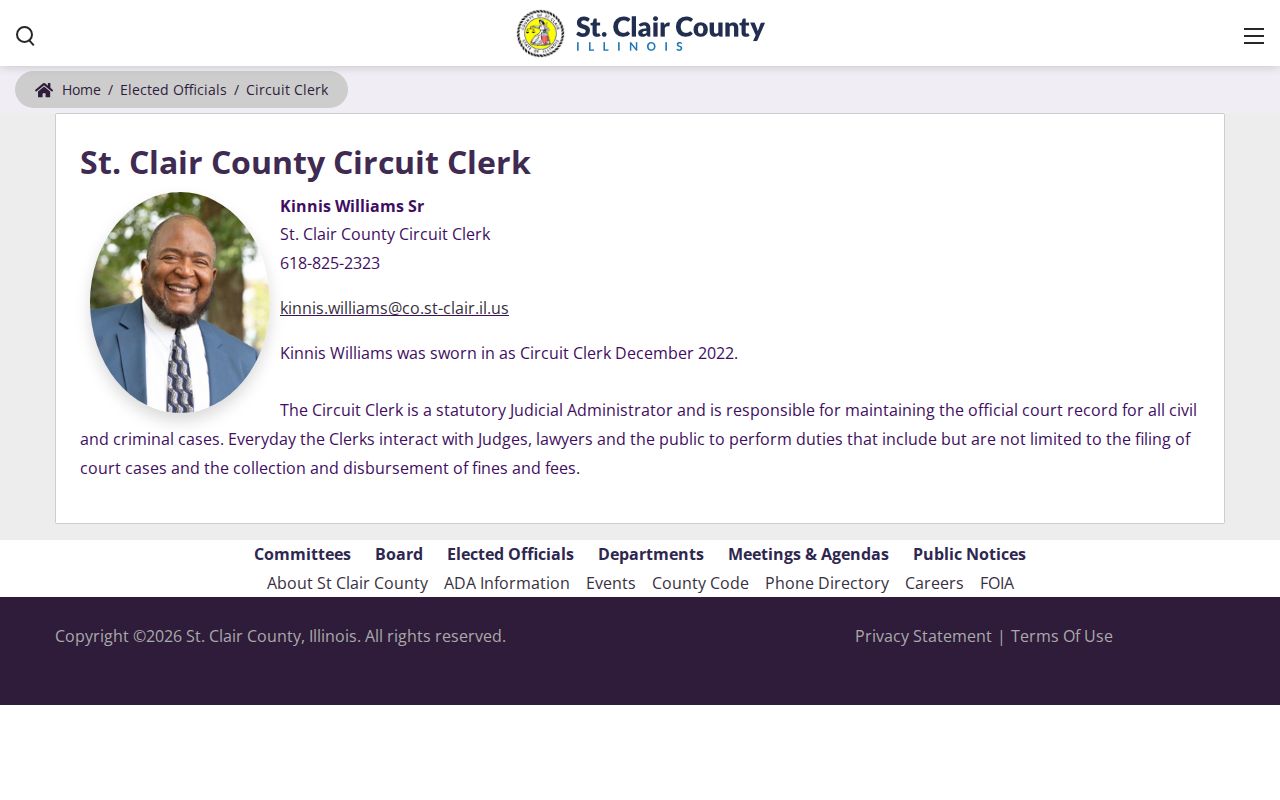
The office shown is the custodian for court filings and certified dispositions, while police and the sheriff keep their own reports.
The first-floor criminal cashier operates from 8:15 a.m. to 4:00 p.m. The third-floor terminals can help with older or offline material that the remote summary does not display. Visitors pass building security and must follow posted rules for portable electronic devices. A person who needs disability access should call ahead; the county directory publishes 711 for hearing-impaired service. Parking terms were not confirmed by the clerk, so posted city street and lot rules should guide a visit.