Sex Offender Checks in St. Clair County
The Illinois State Police Sex Offender Registry is the primary public source for St. Clair County. ISP says the data updates daily. Searchers may look for a person by name and birth date or narrow the public list by city, ZIP code, and county. The county Sheriff's website may direct users to a sex-offender search, but the destination is still the statewide ISP system. No separate St. Clair County public registry was verified.
Begin with broad name fields, then add location or status filters. Similar names require care. Compare aliases, age, physical description, address, offense, photograph, and registering agency before reaching a conclusion. The registry does not include every crime and is not a substitute for the St. Clair County Circuit Clerk's conviction file. For another state's results, add the federal national search layer.
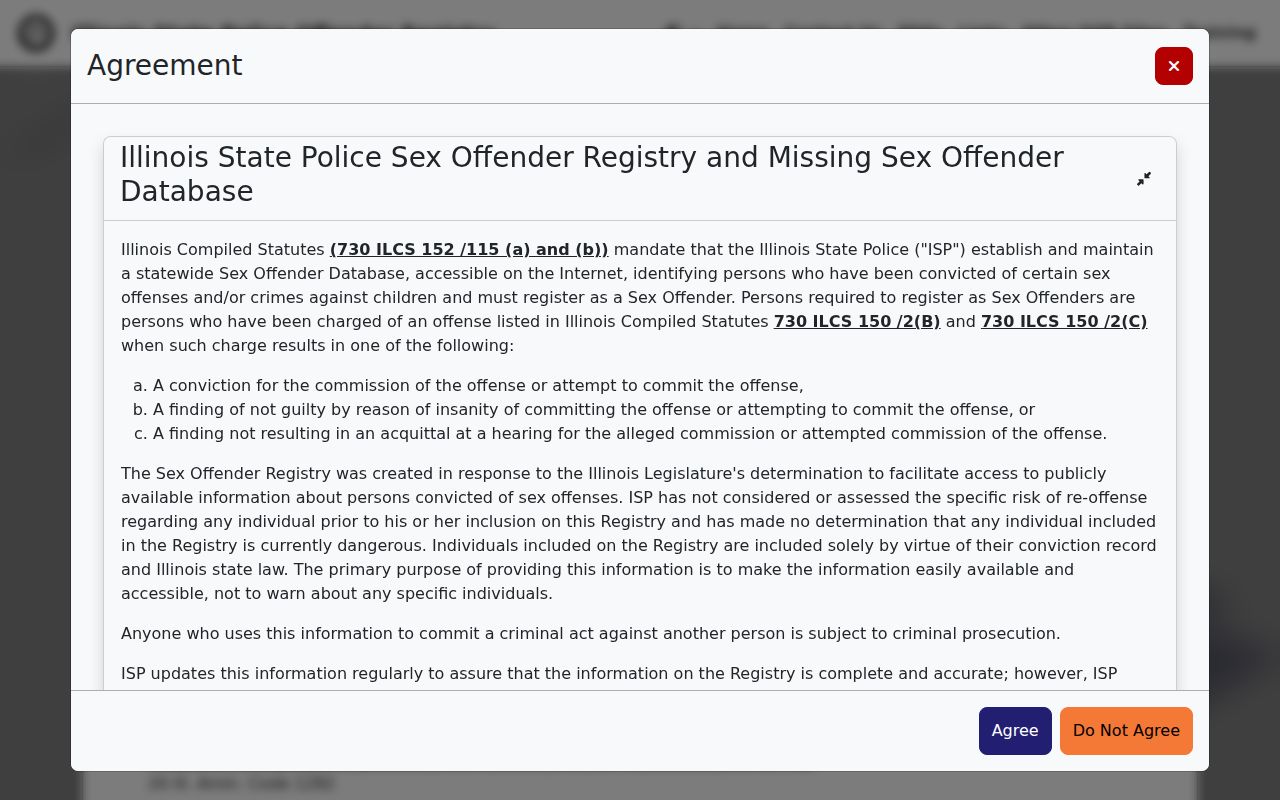
The required terms appear first on the official ISP registry disclaimer.
St. Clair Registry Maps Need Context
ISP's Map Your Neighborhood feature accepts a place and places result markers on a map. A yellow marker opens a detail pane. It can help a household identify nearby public listings, but it is not a risk score. A marker shows that the state database has a mapped public record. It does not rank future danger, confirm that every address is current, or prove that an area without a marker has no safety concerns.
Location filters can also hide a relevant result. A person may be incarcerated, registered out of state, listed as homeless, or associated with another Illinois city. Search by name as well as geography. For personal and family safety, treat the map as one official data point and use ordinary precautions that do not depend on a person's registry status.
How to Search the Illinois State Police Sex Offender Registry
The ISP interface requires users to read a disclaimer and choose AGREE before the search form opens. Most fields are optional, so one search can be widened or narrowed. Start with the name. A St. Clair County filter is useful for a local list, while city and ZIP fields help with Belleville, O'Fallon, East St. Louis, and other communities.
- Open the ISP registry, read the lawful-use terms, and select AGREE.
- Enter first and last name, or select St. Clair from the county control for a geographic search.
- Add date of birth, city, ZIP code, status, homeless, or offender-type filters when the first result set is broad.
- Open Details and compare the full profile, registering agency, offense, and verification information.
| Field | Type | Required | Use |
|---|---|---|---|
| First and Last Name | Text | No | ISP advises starting with a person's name. |
| Date of Birth | Date/text | No | Helps separate similar names. |
| City and ZIP Code | Text | No | Narrows an Illinois location. |
| County | Dropdown | No | Select St. Clair, incarcerated, or out of state. |
| Status and Offender Type | Dropdown | No | Filters statutory category or compliance status. |
| Homeless | Checkbox | No | Includes the transient or homeless category. |
| Map Your Neighborhood | Map | No | Uses an address or map location to display markers. |
The controls are shown on the official Illinois registry search.
Verify St. Clair Registry Entries
Daily ISP updates do not remove the need for local verification. Registration data is supplied through the responsible local agency and may include facts reported by the registrant. A recent move, data-entry problem, or incomplete match can affect what appears. The profile's registering agency is the right first contact for an address, status, or verification concern.
If a St. Clair County profile seems inaccurate, save the public record details without republishing them. Contact the listed police department or the St. Clair County Sheriff, depending on the profile. Court papers come from the clerk in the county of conviction. Incident reports come from the agency that handled the event. For suspected noncompliance, report the facts to the agency where the person resides or registers. Call 911 only for an emergency.
Inside a Registry Profile
A public profile combines identity, appearance, location, offense, and registration facts. Details can change with law and interface updates. The public view may omit victim identity, investigative narratives, and nonpublic criminal-history material. The displayed qualifying offense also does not tell the whole procedural history. Review the underlying court judgment when the exact conviction and sentence matter.
| Name and Aliases | Current name and other reported names that help match identity. |
|---|---|
| Photo and Description | Photograph, sex, race, age or birth date, height, weight, hair, eyes, and identifying marks. |
| Address and Agency | Public registration location, jurisdiction, and the police department or sheriff maintaining the registration. |
| Offense | Qualifying offense description, statute, conviction or adjudication date, and county or state. |
| Category | Illinois statutory offender classification rather than a simple federal tier label. |
| Registration Status | Compliance state, last verification, and other public registration details. |
Some profiles may also show school, work, or vehicle information when the statute and interface permit public display. Details is the control that opens the full individual record from the results list.
St. Clair and National Registry Searches
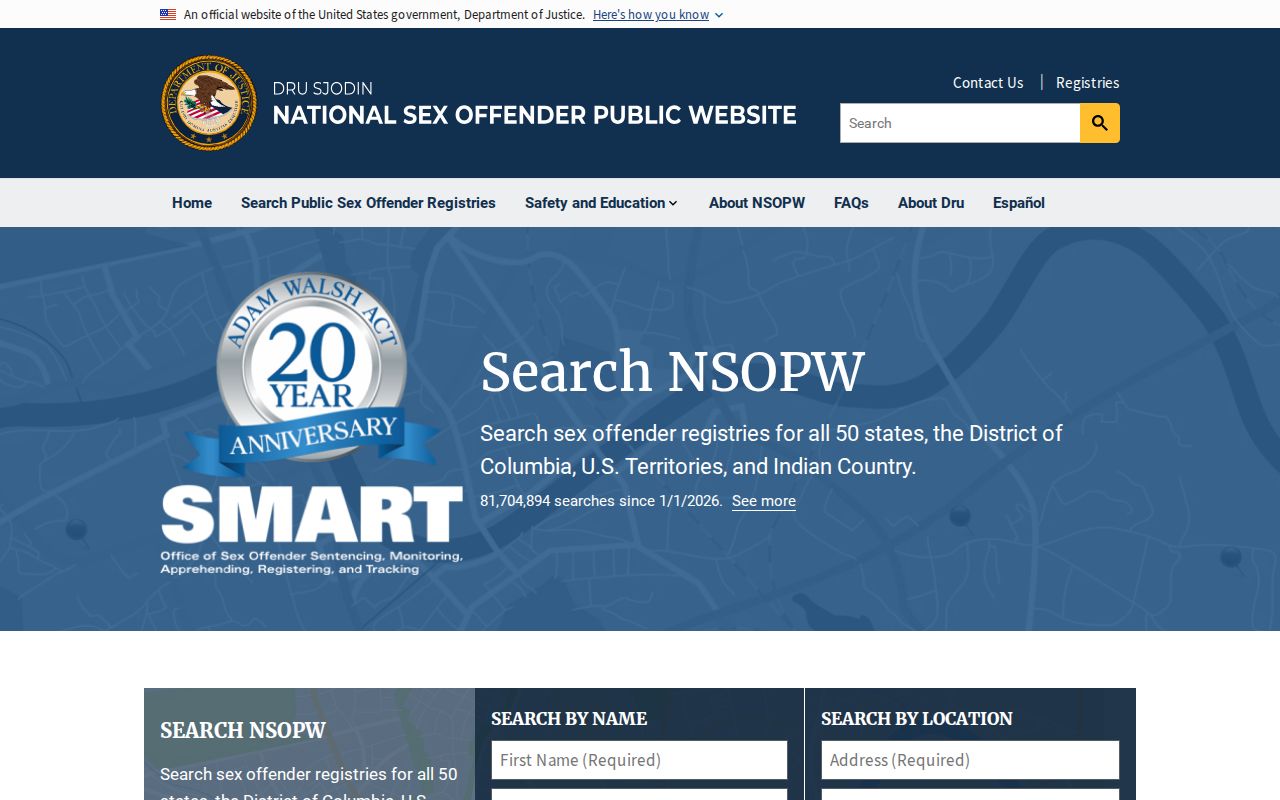
The ISP search is the best layer for Illinois registration details. The Dru Sjodin National Sex Offender Public Website, or NSOPW, searches participating jurisdictions across state, territorial, and tribal lines. That added range matters in the St. Louis metro area, where normal travel crosses the Mississippi River. A St. Clair County-only filter will not find a Missouri registration.
NSOPW does not replace the source registry. Open the contributing jurisdiction's profile when a national result appears, then use that jurisdiction's registering agency for accuracy questions. Search gaps can arise from name variation, location changes, or a jurisdiction's update cycle. An absent result is not a safety guarantee.
Cross-state searching begins at the official National Sex Offender Public Website.
Illinois Registration Levels and Requirements
Illinois does not present its public registry as a basic Tier I, Tier II, and Tier III system. State statutory categories control duration and verification. A sex offender who is not classified as a sexual predator generally registers for ten years after conviction, release, or parole and generally reports annually. A sexual predator generally registers for life and verifies quarterly. Other life categories have duties set by the governing statute.
| Illinois category | General duration | General verification |
|---|---|---|
| Sex offender not classified as sexual predator | Generally 10 years | Generally annual |
| Sexual predator | Natural life | Generally quarterly |
| Sexually dangerous or sexually violent person and other life categories | Natural life | Enhanced schedule as the statute specifies |
| Murderer and Violent Offender Against Youth | Separate registry rules | Do not conflate with the sex offender registry |
Time can be extended or tolled during incarceration or noncompliance. Tolling means the registration clock stops for a period defined by law. Offense-specific rules matter, so a profile label alone should not be used to calculate an end date.
The category and duration framework comes from the official Illinois Sex Offender Registration Act.
Route St. Clair Registry Records
A registry profile, registration form, court judgment, and police report answer different questions. ISP publishes the searchable notification profile. The listed registering police department or Sheriff maintains registration details and receives accuracy or noncompliance reports. The Circuit Clerk in the county of conviction keeps the judicial file. The agency that investigated an event keeps its report.
Send each request to its custodian. Asking ISP for a police narrative or the St. Clair County Circuit Clerk for a current registration address will not produce the right record. If the goal is to understand the conviction, search the case docket and request the judgment. If the goal is to report a possible registration violation, contact the registering agency. If the event occurred outside Illinois, start with that jurisdiction's registry and court.
Illinois criminal-record boundaries are also reflected in the Criminal Identification Act.
St. Clair Residency Rules Vary
Illinois residency and presence restrictions are status-specific. They do not create one universal distance rule for every person on the registry. The offense, category, date, and statutory terms control. Local address facts can also differ from the assumptions suggested by a map marker. For that reason, do not use a homemade radius to declare that an address is lawful or unlawful.
Questions about a particular registrant's compliance belong with the listed registering agency. A public profile can support community awareness, but law enforcement and courts determine violations. The same caution applies to schools, parks, child-care sites, and other places addressed by distinct Illinois provisions. Report concrete facts. Do not confront a listed person or household.
Community Notification and Lawful Use
Illinois created public registry access for notification and safety awareness. ISP expressly warns that the information may be inaccurate and that a listing does not predict future conduct. Use a St. Clair County result to inform calm safety planning, confirm the current official profile, and reach the responsible agency when a fact appears wrong. Never republish a profile as an accusation of new conduct.
Use registry information lawfully: Do not harass, threaten, stalk, or intimidate a listed person or household. Such conduct may violate Illinois criminal law.
Public notification rests on Illinois law, while local agencies supply and verify registrations. The legal warning applies even when information is easy to find. Emergencies go to 911. Suspected noncompliance should be reported to the listed registering agency with specific facts rather than posted publicly.
The public-notification basis is set out in the official Illinois Sex Offender Community Notification Law.